
Plinko odds are a textbook case of the binomial distribution, which is good news: unlike slots, you can compute every probability yourself from first principles and check that the casino's RTP claim is true. This guide walks through the maths and then shows the numbers for every board.
Why the centre is common and the corners rare
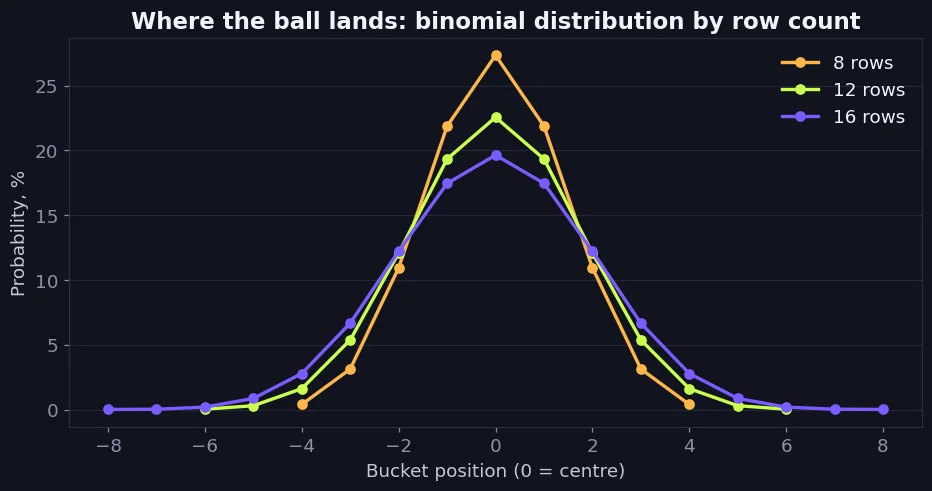
Each peg is a fair coin-flip. On a 16-row board the ball flips 16 coins; to land in the far-left bucket all 16 must come up "left", a 1-in-65,536 event. To land in the centre bucket exactly 8 of 16 must come up left, and there are C(16,8) = 12,870 ways for that to happen – so the centre collects 12,870/65,536 = 19.6% of drops. The general formula is P(bucket k) = C(n,k) / 2n.
| Rows | Buckets | Corner odds | Centre bucket(s) | Middle 3 buckets |
|---|---|---|---|---|
| 8 | 9 | 1 in 256 | 27.3% | 71.1% |
| 10 | 11 | 1 in 1,024 | 24.6% | 65.6% |
| 12 | 13 | 1 in 4,096 | 22.6% | 61.2% |
| 14 | 15 | 1 in 16,384 | 20.9% | 57.6% |
| 16 | 17 | 1 in 65,536 | 19.6% | 54.6% |
From probabilities to RTP
RTP is the sum over all buckets of probability × multiplier. For 16 rows medium risk: 2 × (1/65,536) × 110 for the corners, plus 2 × (16/65,536) × 41 for the next pair, and so on inward to 12,870/65,536 × 0.3 for the centre. Add it up and you get 98.99%. The odds calculator does this for all 27 boards, and every one of them lands between 98.9% and 99.2%.
What "99% RTP" means in practice
It means that for every $100 you wager, you lose $1 on average. Not per session – on average, over an unbounded number of drops. In any given hour you might be up 40% or down 60%; the average only asserts itself over tens of thousands of drops, which is exactly why variance (the next section) matters more to your experience than RTP does.
Variance: the number that actually shapes a session
Two boards can have identical RTP and feel like completely different games. Standard deviation per drop, expressed in bets, captures the difference: about 0.9 for 16 rows low risk, 2.5 for medium and 5.5 for high. A 500-drop session's standard deviation is √500 ≈ 22 times that figure – so roughly ±20 bets on low risk and ±125 bets on high. The expected loss over the same 500 drops is 5 bets. On high risk the noise is 25 times the signal.
How rare is the 1000×?
Either corner on 16 rows hits 1 in 32,768 drops. At 20 drops a minute that is a 27-hour expectation; most players never see it. The two 1000× buckets together contribute 3.05 percentage points of the 98.98% RTP – all of it concentrated in outcomes you will almost certainly not experience, which is why high risk feels like it loses far more than 1%.