
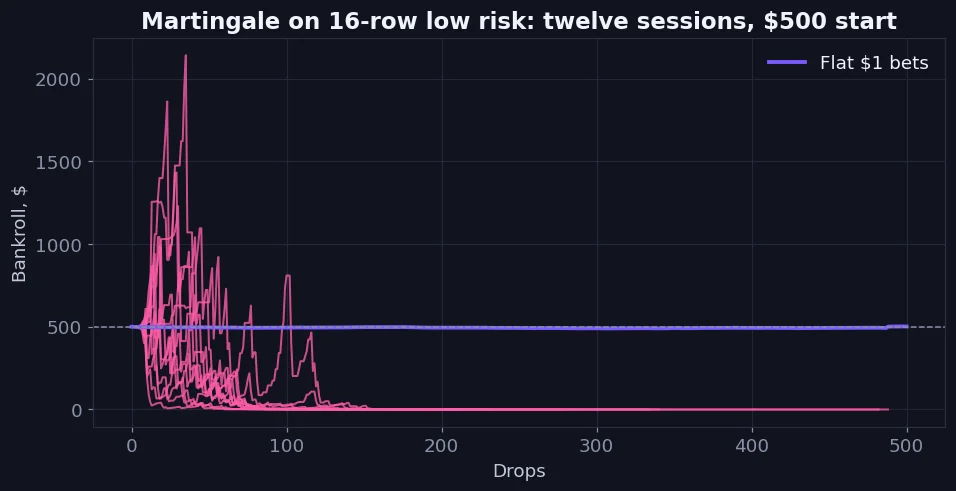
Martingale – double your bet after every loss, return to base after a win – is the most-asked-about Plinko "strategy", usually applied on low risk where a 1× or better bucket counts as a win. We simulated it properly: 50,000 sessions, real 16-row low-risk paytable, $1 base bet, $500 bankroll, 500 drops per session, stopping at a win of +$50 or at bust.
The results
| Metric | Martingale | Flat $1 bets |
|---|---|---|
| Sessions ending in profit | 81.4% | 43.7% |
| Sessions ending bust | 17.9% | 0.1% |
| Average result per session | −$46.70 | −$4.90 |
| Average total wagered per session | $4,680 | $490 |
| House edge × wagered | −$46.80 | −$4.90 |
| Longest losing streak observed | 14 | 14 |
Four out of five Martingale sessions ended up a little; one in six lost the entire $500. The average loss per session was almost ten times the flat-betting loss – and it equalled, to within rounding, the house edge multiplied by the total amount wagered. That last line is the whole story: Martingale did not change the edge, it multiplied the wager volume, and the loss followed.
Why it fails on Plinko specifically
On low risk, "win" buckets include 1× and 1.1×, which do not recover a doubled stake. A 1× result after a $64 bet is a push, not a win, so the progression has to continue. A proper Martingale needs a ≥2× threshold, which hits on only about 15% of drops on 16 rows low, and a losing streak of 10 at that rate is routine. The required bankroll to survive ten doublings from $1 is $1,023; from $5 it is over $5,000; and the table maximum at most brands caps the progression before that anyway.
Reverse Martingale, D'Alembert, Fibonacci
We ran them too. Each reshapes the distribution of session outcomes – Paroli produces many small losses and rare large wins, D'Alembert something close to flat betting – and each loses house edge × total wagered on average. There is no progression that does otherwise, because there is no progression that changes the paytable.
If you still want to use one
Use it with the knowledge of what it does: it buys a higher chance of a small win with a smaller chance of a large loss. Set a hard loss limit, use the auto-bet stop, and run it first on the low-risk simulator with play money until you have seen a bust. Then run your actual numbers through the bankroll calculator.